
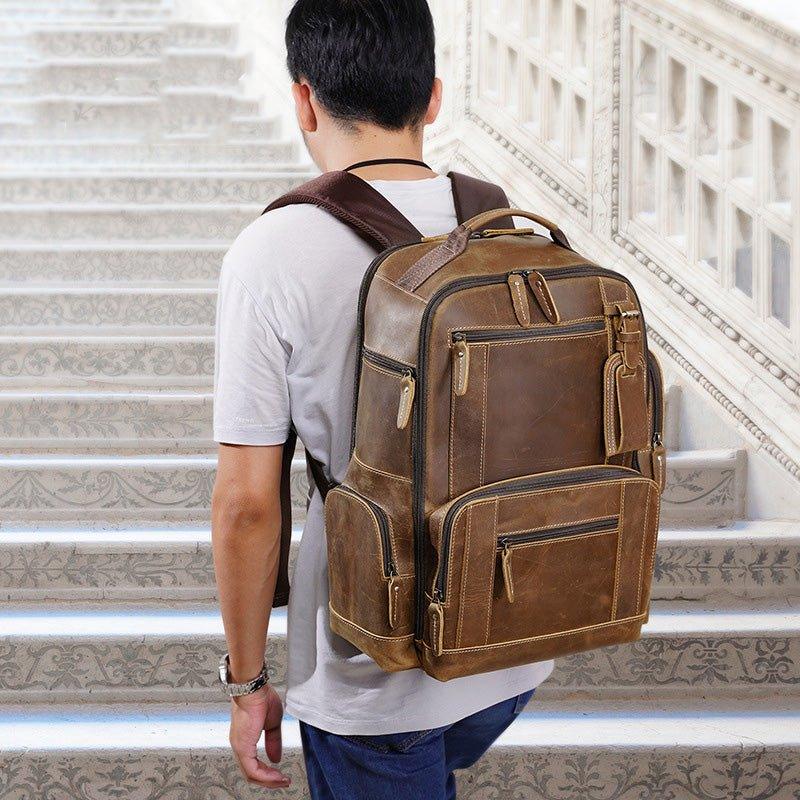
What Is the Best Leather Backpack for College and Why Do Students Who Buy Leather Never Go Back to Synthetic?

A leather backpack for college is a full-grain or top-grain leather bag sized for the academic carry — typically 20 to 28 litres — with a padded laptop compartment, textbook-depth main section, organiser pockets for stationery and personal items, and durable construction designed to survive 3 to 4 years of daily campus use including lecture halls, libraries, cafeterias, outdoor quads, and public transport commutes.
College is the most demanding use case for any backpack on the market. A student carries 5 to 10 kilograms daily across campus for 8 to 12 hours, five or six days a week, for three to four consecutive years. That is roughly 3,000 carry cycles across the duration of a degree. Most synthetic bags are visibly worn by year two — fraying at stress points, faded from sun exposure, and losing structural integrity at the zipper tracks and shoulder strap anchors. By year three, they are functionally compromised.
A leather backpack for students survives the full degree and keeps going into the post-graduation professional years. The economics are counterintuitive but decisive once you run the numbers. This guide covers the cost comparison, sizing for different academic loads, the features that matter most for campus life, and what separates a bag that lasts through graduation from one that barely survives freshman year.
Why Is a Leather Backpack a Smart Investment for College Students?
The cost argument is counterintuitive but straightforward. A mainstream synthetic campus backpack costs $40 to $80 and lasts 1.5 to 2 years under the punishing daily use that college demands. Over a 4-year degree, a student buys 2 to 3 replacement bags — spending $80 to $240 total — and graduates with a worn-out bag heading for the bin and zero carry value for the working years ahead.
A leather campus backpack costs $150 to $300 and lasts the entire 4-year degree plus another 10 to 15 years of post-graduation professional use. The student graduates with a bag that has developed genuine character, a rich patina from thousands of campus hours, and personal history written into the leather — and then continues using it for their first decade of professional life.
The per-year cost calculation is definitive: $150 over 15 years = $10 per year. $60 per bag times 3 replacements over 6 years = $30 per year. Leather costs less, lasts longer, produces less waste, and looks better at the end than synthetic looks at the beginning.
What Size Leather Backpack Works for College?
| Student Type | Volume | Fits | Recommended |
| Light carrier (tablet + notes) | 15–20L | Tablet, notebook, water bottle, wallet | Slim leather daypack |
| Standard student | 20–25L | 14–15 inch laptop, 2–3 textbooks, essentials | Mid-size leather campus backpack |
| Heavy carrier (STEM / law) | 25–30L | Laptop, 4+ textbooks, lab materials, lunch | Full-size leather rucksack |
| Commuter student | 25–28L | Laptop, books, lunch, change of clothes, gym gear | Structured leather backpack |
The 20 to 25-litre range serves 80% of college students. This volume handles a 15-inch laptop, 2 to 3 full-size textbooks, a water bottle, and daily essentials without the bag looking overpacked or losing its structured silhouette. Only size above 25 litres if you carry STEM lab materials, law casebooks, or combine your academic carry with gym gear in a single bag.
What Features Do College Students Need in a Leather Backpack?
Padded laptop compartment.
Non-negotiable for any student carrying a laptop to campus daily. A 14 to 15-inch padded sleeve with soft lining protects the most expensive single item a student owns. Back-panel positioning puts the laptop weight closest to the spine for the best weight distribution during long campus walks between buildings.
Textbook-friendly main compartment depth.
Academic textbooks are 3 to 5 centimetres thick per volume. The main compartment needs 15+ cm of depth to stack 2 to 3 textbooks flat alongside the laptop compartment without straining the zipper or forcing the bag to bulge. Bags designed for casual use often lack this depth.
External water bottle pocket.
Isolated side pocket keeping water bottles physically separated from electronics, paper, and textbooks. A single spill or condensation leak inside a shared compartment can destroy a $1,500 laptop and a semester’s worth of handwritten notes simultaneously. This pocket is not optional.
Front organiser pocket.
Pens, USB drives, student ID card, transit pass, earbuds, phone charger, portable battery — a dedicated organiser with 4+ slip pockets eliminates the dig-and-search delay between every class, every building entry, and every transit stop. Students who use bags without organisers lose cumulative hours per semester to searching.
Wide padded shoulder straps.
Students carry heavy loads across campus all day. Straps under 5cm wide create painful pressure points within the first hour of a loaded carry. Padded wide straps distribute 5 to 10kg loads across the full shoulder surface and prevent the strap-dig that makes afternoon classes uncomfortable.
Reinforced base panel.
College backpacks sit on lecture hall floors, cafeteria tiles, library carpets, outdoor grass, and rain-wet pavement. A reinforced or double-layered leather base panel resists moisture absorption, scuffing, and the gradual base discolouration that ages a bag prematurely.
How Does a Leather College Backpack Handle Daily Campus Life?
Rain: Apply a water-resistant leather spray at the start of each semester — twice per academic year. This creates a surface barrier that gives you a working margin in light rain and drizzle, enough to walk between buildings without water spotting. In heavy downpours, the included dust bag doubles as a quick rain cover during transit.
Weight: A fully loaded college bag weighing 7 to 10 kg is well within the comfort range of a properly designed leather backpack with wide padded straps. The key to comfort is packing heavy items — textbooks and laptop — against the back panel. This keeps the weight centred over your spine rather than pulling the bag backward away from your body.
Wear and ageing: The high-contact areas of a daily campus bag — handles, strap attachments, front flap, and the zip pull zone — will darken noticeably within the first semester. This is patina forming, not damage occurring. By second year, the bag has a lived-in character that tells the story of its campus life. By graduation, it is unmistakably yours in a way that a new replacement could never replicate.
Browse the complete Rustic Town leather backpack for students collection — built to last through your degree and beyond into your professional career.
See also Rustic Town’s college leather bag range for campus-specific designs with academic carry in mind.
Frequently Asked Questions
Q: What is a leather backpack for college?
A: A durable, full-grain leather bag at 20 to 28 litres with padded laptop protection, textbook-friendly depth, organised pockets, and construction designed to survive 3 to 4 years of daily campus use — then continue into professional life after graduation.
Q: Is a leather backpack too expensive for a college student?
A: The upfront cost is higher but the per-year cost is lower. A $180 leather bag lasting 15+ years costs $12 per year. Two synthetic bags at $60 each over 4 years cost $30 per year. Leather is the budget-smart long-term choice.
Q: Can it hold textbooks and a laptop at the same time?
A: Yes. A 22 to 25-litre leather backpack comfortably holds a 15-inch laptop, 2 to 3 full-size textbooks, a water bottle, and daily essentials.
Q: Will rain ruin a leather college backpack?
A: No. Treated full-grain leather handles light rain without damage. Apply a water-resistant spray each semester, wipe the bag dry after exposure, and condition quarterly.
Q: How heavy is a leather backpack empty?
A: 1.0 to 1.5 kg — comparable to premium synthetic campus backpacks and lighter than many technical laptop bags.
Q: Will the leather backpack still look good after 4 years of college?
A: It will look better. Full-grain leather develops a rich patina from daily handling that gives the bag a distinctive, characterful appearance no new bag can replicate.
Written by the Rustic Town Editorial Team | Updated January 2026
Rustic Town has been handcrafting leather goods in Rajasthan, India since 2013. Every bag in the collection uses full-grain or vegetable-tanned leather, brass hardware, and hand-stitched construction built to last decades.

Comments are closed.